Our WRAP-UP NEXT preorder window closes on April 15th 2026 - Preorder your FR-D7 today!

FR-D7 TUNING: DUAL FACE SUSPENSION MOUNTS
Unlock the full potential of your FR-D7 chassis with our deep dive into the Dual Face Suspension Mount system.
WRAP-UP NEXTFR-D7
Luke Pettigrew
7/20/20264 min read
1. Understanding Dual Face Suspension Mounts
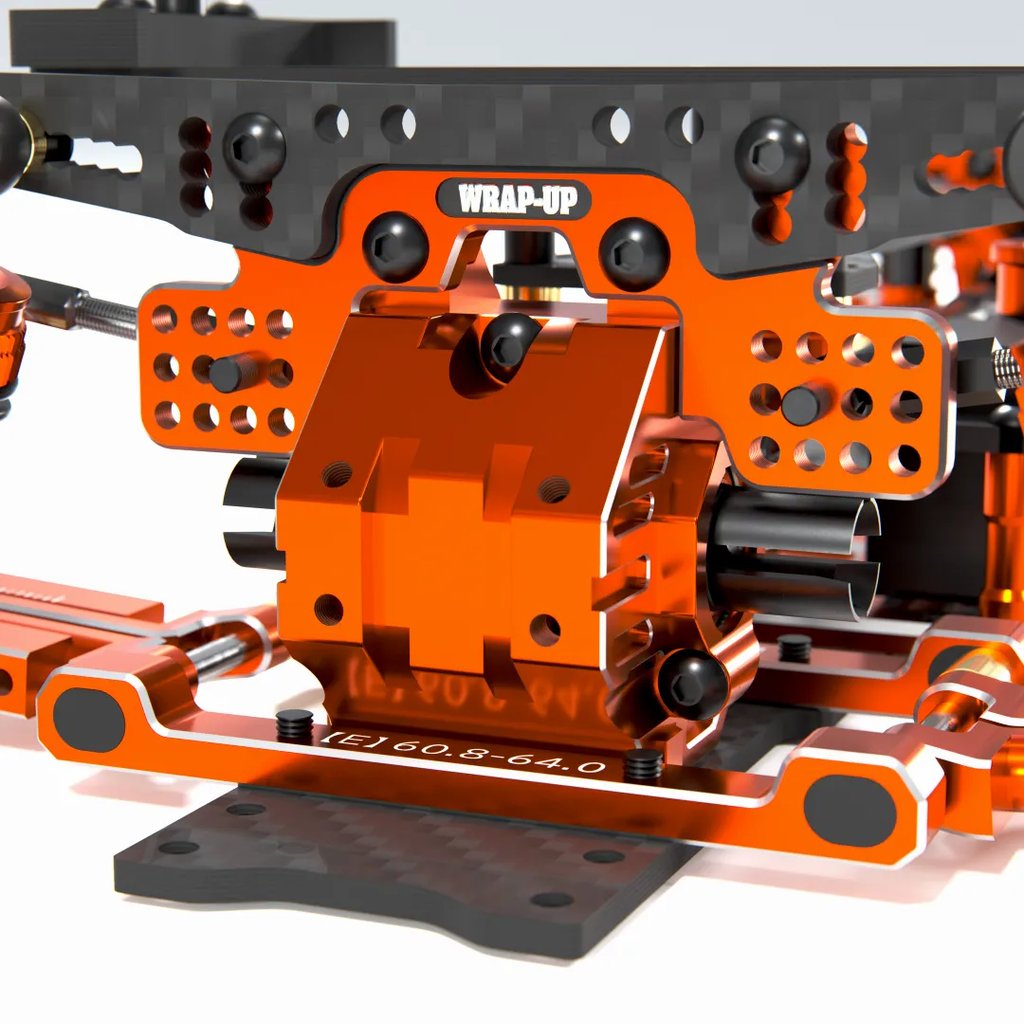
The Dual Face Suspension Mounts are a core tuning point on the FR-D7. They directly influence how the rear of the car generates grip, transitions between angles, and responds to throttle input. While the Plus Kit comes with these parts as standard, they are also available to be purchased separately in each type for those building from the Core Kit.
Suspension mounts define the pivot points for the lower arms, which directly dictate rear geometry and overall chassis behaviour. While this area can initially seem complex, it is one of the most effective ways to fine-tune chassis behaviour in a controlled and repeatable manner.
Each section of this guide focuses on a single adjustment—such as track width, toe angle, roll centre, and skid angle—and its effect on the car. By the end of this guide, you should be able to make changes with intent to suit your driving style, ensuring that every adjustment is made with purpose rather than trial and error.
2. Mount Selection and Inclusion
The FR-D7 Plus Kit provides two mount widths, which define the baseline track width and geometry range. You can purchase them separately here.
Included options:
Type E: 60.8mm–64.0mm
Type C: 46.4mm–49.6mm
These mounts allow adjustment of:
Track width
Chassis response
Suspension geometry
They also align with the FR-D7’s adjustable wheelbase (240mm–270mm). Using Type C allows the rear track width to better match shorter wheelbases, supporting M-chassis style setups.
On-track effect:
The chosen width sets the base behaviour of the chassis before any fine tuning.
3. Mount Types Characteristics
Mount width defines the base handling profile of the chassis.
Wide Mounts (Type E / 60.8–64.0mm)
Key characteristics:
More aggressive and direct
Faster transitions
Increased forward drive
A notable reduction in chassis roll
On-track effect:
Selecting wider mounts ensures the car feels sharper and more immediate, with less body movement and a significantly quicker response during high-speed transitions.
Narrow Mounts (Type C / 46.4–49.6mm)
Key characteristics:
Smoother and more stable
Increased lateral grip
A more natural and progressive chassis roll
Narrow setups also pair well with FSG2 arms for reduced track width builds.
On-track effect:
Choosing a narrow setup makes the car feel more progressive and forgiving, which provides improved side bite and smoother weight transfer on technical tracks.
On-track effect:
Track width changes influence stability and grip balance, while mixed positions allow controlled toe adjustments.
4. Suspension Bushing Width Adjustment
Bushing position controls hinge pin width, which directly sets track width and enables toe adjustment.
Compatible Bushings
Yokomo (B8-301BSA)
Rêve D (RD-300BS)
Other brands may work, but are not confirmed.
What the Bushings Do
Adjusting bushing position changes:
Track width
Relative mount spacing
Toe potential (when mismatched front to rear)
Bushing Reference Table
Coming soon!
5. Suspension Bushing Toe Adjustment
Toe is created by running different bushing positions between the front and rear mounts.
Key Variables
Width difference between mounts
Mount spacing
The FR-D7 supports:
40mm spacing
48mm spacing
Calculation
40mm spacing: width difference × 0.72
48mm spacing: width difference × 0.60
Example
FR: 46.4mm (Inner 5 / E)
RR: 48.0mm (Center / A)
Width difference = 1.6mm
At 48mm spacing:
1.6 × 0.60 = 0.96° toe-in (≈ 1°)
On-track effect:
Increasing toe-in improves rear stability and forward drive while effectively reducing the car's tendency to rotate.
6. Mounting Orientation
Altering the mount orientation changes the roll centre height, which controls how the chassis manages weight transfer during cornering.
Standard Mounting (Flat Side Down)
Key changes:
Significantly raises the roll centre
Reduces chassis roll
On-track effect:
Standard mounting significantly raises the roll centre. This results in a chassis that feels flatter and more direct, making it best suited to high-grip surfaces where stability is paramount.
Flipped Mounting (Upside Down / 4mm Drop)
Key changes:
Lowers the roll centre
Increases chassis roll
On-track effect:
Conversely, flipped mounting lowers the roll centre. The car gains more mechanical grip and becomes more forgiving, allowing for better performance on lower grip surfaces.
7. Skid Angles
Skid angle introduces a forward or rearward tilt to the lower arms, affecting how the chassis reacts under load.
Baseline Setup
+1mm under FF mount (Note the FR-D7 does not have this adjustment)
+1mm under RF mount
Key Effects
Front (FF raised):
Creates anti-dive
Reduces front compression under deceleration
Rear (RF raised):
Creates anti-squat
Improves forward drive and throttle response
Additional note:
Raising the RR mount increases visible squat under acceleration
On-track effect:
Strategic skid angle tuning refines how the car transfers weight under braking and throttle, directly influencing consistency and drive out of corners.
8. Conclusion
The Dual Face Suspension Mount system on the FR-D7 is not merely a single adjustment, but a comprehensive framework for shaping chassis behaviour. By coordinating mount width, bushing position, orientation, and skid angle, you can precisely define how the car generates grip and transfers weight.
Key takeaway:
Small, deliberate changes here produce meaningful and predictable differences on track.
Combining these adjustments allows you to set a solid foundation with track width, refine stability via toe-in, control responsiveness through the roll centre, and fine-tune weight transfer with skid angles.
On-track reality:
A well-structured setup using the Dual Face Suspension Mounts will feel:
Consistent in transitions
Stable under throttle
Predictable at angle
Tuned to the surface, not fighting it
As you move forward in the series, the goal is to build on this foundation. With a clear understanding of how each adjustment behaves, you can begin to layer changes confidently and develop setups that suit both your driving style and the conditions you are running in,
9. Sources
New Product Announcement Vol. 215: Dual Face Suspension Mount
https://ameblo.jp/wrap-upnext08/entry-12823282410.html
Dual Face Suspension Mount User Guide
https://ameblo.jp/wrap-upnext08/entry-12823943493.html
New product shipping! Dual-face suspension mount
https://ameblo.jp/wrap-upnext08/entry-12826082081.html

Copyright © Zerofeel -All rights reserved